Where Eastern Suburbs laundries actually are
In the basement or on the roof. Many interwar walk-ups were built with a shared laundry, and plenty of units still have nothing inside. Adding one is often the highest-value change available in the flat.
Inside the bathroom. A washing machine squeezed next to the toilet, drying rack over the bath. It works, but rarely tidily.
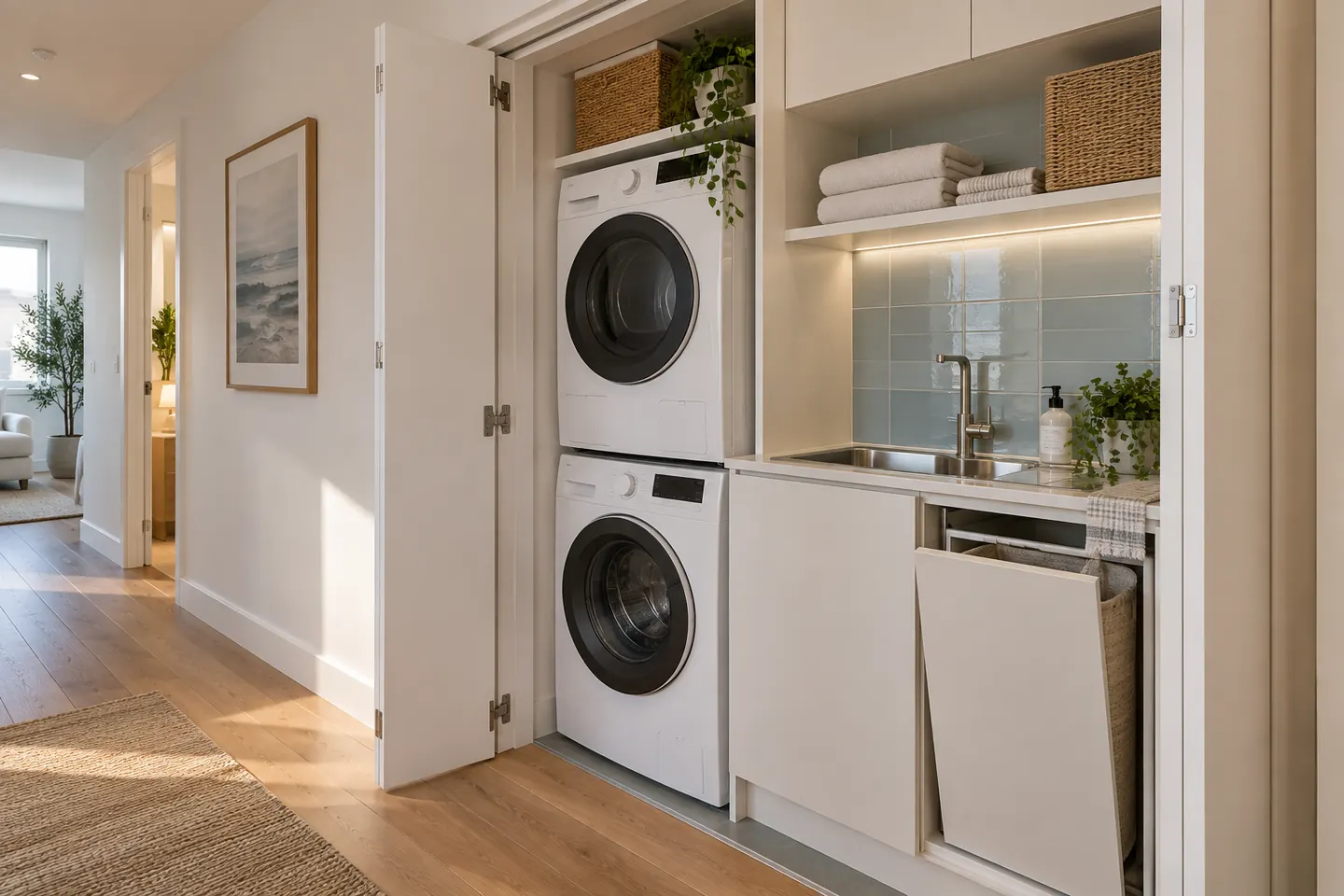
In a hall cupboard. A European laundry — machines and a small tub behind doors — is well suited to apartments and was widely adopted in newer blocks.
At the back of a semi or terrace. A rear room, often in a lean-to, often built in fibro or with old sheeting, often with the original concrete tub.
European laundries
A cupboard laundry needs four things, and knowing them in advance saves wasted design:
- A cold and hot supply within reach, with accessible isolation taps.
- A waste connection for the machine and the tub, with a trap and air gap.
- A floor that can take water — waterproofed, and ideally with a floor waste or a safe tray under the machine.
- A drying plan. In an apartment without a balcony, that usually means a heat pump dryer, which does not need an external vent and runs far cheaper than a vented unit.
Doors are the other decision. Bi-folds need clearance in front, pocket doors need a wall with space to take them, and standard hinged doors need a hallway wide enough to swing into. We draw the options against the actual hallway width.
Laundry rooms in houses
In older semis and bungalows, the rear laundry is usually the least maintained room in the house. Common findings when it comes apart:
- Fibre cement lining containing asbestos in rooms built before about 1990 — tested before anything is removed
- A concrete floor without fall to the waste, so water sits where it lands
- Old galvanised supply pipes with poor flow
- No exhaust, with mould on the ceiling after years of indoor drying
A good renovation deals with all four and then adds what a family laundry needs: a proper benchtop for folding, hanging space for drip-drying, tall storage for the ironing board and vacuum, and a tub big enough to soak things in.
Combining the laundry with a bathroom renovation
If the bathroom is being renovated anyway, relocating the laundry into it — or out of it — is best decided now. The plumber, the waterproofer and the tiler are already on site, so the marginal cost of the laundry work is much lower than doing it as a separate job later.
Where the laundry goes into the bathroom, we plan for:
- Machines stacked in a tall cupboard, doors clear of the shower glass
- A condenser or heat pump dryer, to avoid adding humidity to a room already fighting it
- Separate isolation taps so the machines can be shut off without cutting water to the basin
Materials near the coast
The same salt-air rules apply in a laundry as in a bathroom. Choose cabinet hardware with a quality finish, specify moisture-resistant carcasses, and make sure the exhaust actually leaves the building. Laundries in basement-level garages in Bondi and Coogee buildings are especially prone to condensation.
Benchtops
Engineered stone has been banned in Australia since 1 July 2024. Laundry benchtops are now typically compact laminate, porcelain slab, solid surface, sealed timber or stainless steel. Compact laminate is very durable around a tub and is a practical choice for a hard-working family laundry.
Strata considerations
Moving or adding a laundry in a unit usually needs owners corporation approval because it adds load to shared plumbing and creates new penetrations. Replacing a laundry like-for-like in the same position, with no change to the membrane, may be treated more simply — but check your by-laws before assuming so. The FAQ covers strata questions in more depth.
Cost
As a 2026 guide: a European cupboard laundry, $12,000 to $20,000; a full laundry room renovation, $16,000 to $28,000. More if new plumbing runs a long distance or asbestos removal is needed. The cost page has the full range.
Renovation work is carried out in partnership with Coastal Renovation Group, a licensed NSW builder — licence and insurance details are provided on request.
Call 02 5121 7922 or send the details through.