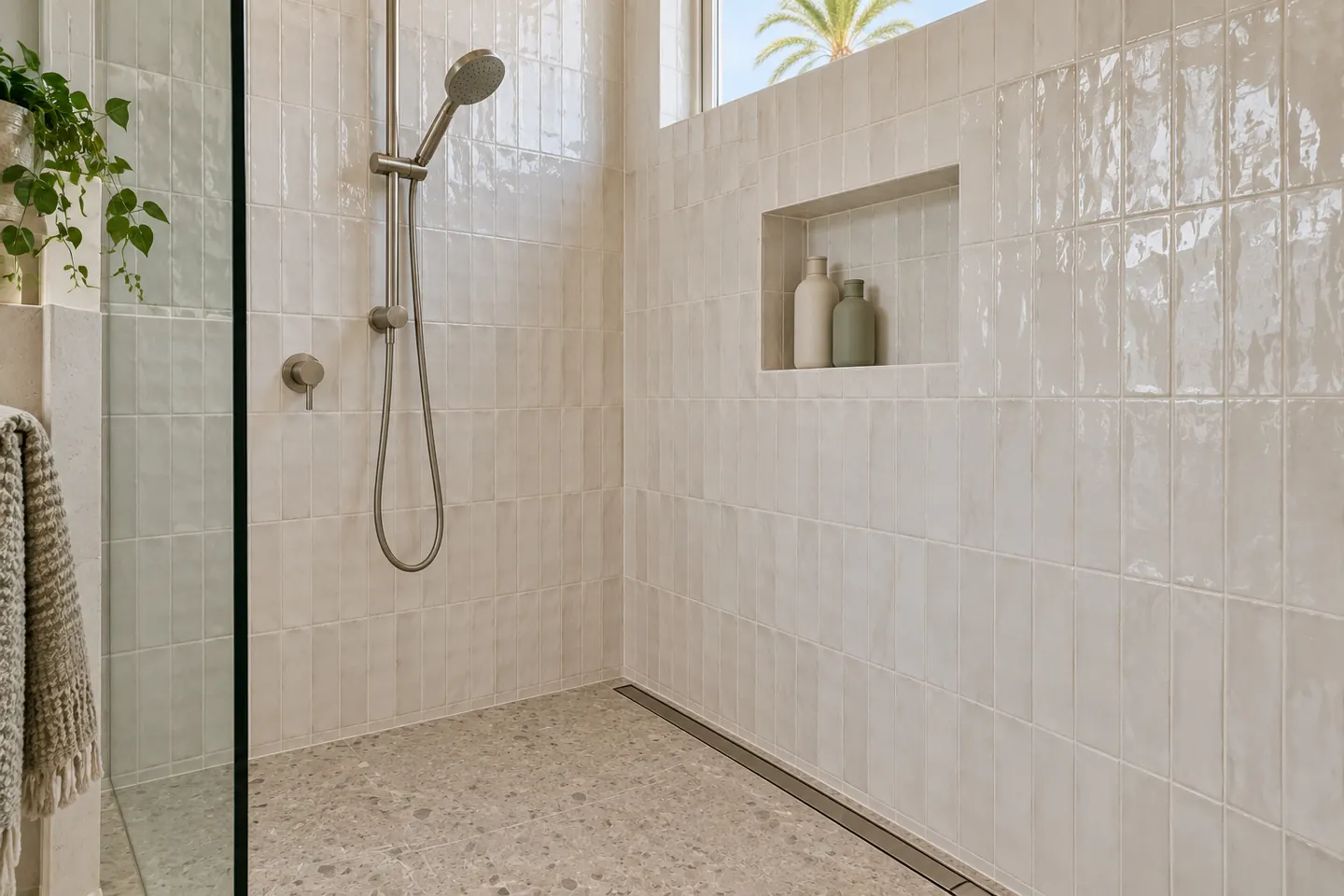
Tile is the room
In a four-square-metre bathroom, tile covers the floor, the shower walls, and often every other wall to the ceiling. There is nowhere to hide an uneven line, a lipped edge or a sliver cut at a corner.
That is why set-out — deciding where every full tile and cut will land before the first one is fixed — is the core of our tiling work.
Set-out before anything else
Before tiling starts, the tiler and the designer agree on:
- Where the grout lines fall relative to the shower glass, the niche, the vanity top and the toilet
- Where cuts go, so they land in corners and behind fittings rather than at the most visible edge
- How the floor tile aligns with the wall tile, so joints run continuously around the room
- Drain position relative to the tile grid, so a linear drain sits on a joint rather than chopping tiles
- Niche size, set to full tile dimensions so it needs no thin cuts
This is also where the plumbing rough-in matters. A mixer placed on a grout line looks deliberate; one placed a few centimetres off looks like an accident. We coordinate outlet positions with the tile layout before the walls are sheeted.
Tile types that suit the east
Large-format porcelain. 600 by 1,200 mm and larger is a strong choice for compact rooms. Fewer joints, calmer walls. It needs very flat substrates and experienced handling, and it is heavy — worth knowing if materials are going up four flights of stairs.
Handmade and glazed wall tiles. Zellige-style and glazed ceramic tiles in soft greens, blues and warm whites suit interwar and art deco flats in Coogee and Bondi. Their variation is the point, but it needs a tiler comfortable with uneven edges.
Terrazzo. Honed terrazzo floor tiles echo the original floors in some mid-century buildings and wear well. They need sealing.
Mosaic for shower floors. A small tile on a shower floor follows the falls neatly and adds grip. Many designers pair a mosaic shower floor with a larger tile elsewhere; others keep one tile throughout and use a linear drain to avoid the need for a change.
Natural stone. Marble and limestone are beautiful and genuinely high-end, but porous and sensitive to cleaning products. In a busy family bathroom we talk through the maintenance honestly before recommending it.
Grout and silicone
Grout colour matched closely to the tile makes a room calmer. Epoxy grout resists staining and water better than cement grout and suits shower floors, though it takes more skill to lay.
Silicone belongs at every internal corner and change of plane — floor to wall, wall to wall, tile to bath or vanity. It is a maintenance item that should be inspected every few years, particularly in humid coastal apartments.
Working with old buildings
Walls are rarely straight. Double brick in a 1930s flat can be several millimetres out over a metre. Large tiles expose that. Walls may need straightening with new sheet linings or render before tiling.
Floors are rarely flat. Removing old mortar beds leaves uneven slabs. The new screed provides the flat, falling surface the tiles need.
Heritage features. Some owners want to keep or echo original features — a band of period tiles, a patterned floor, a coloured skirting tile. Matching is sometimes possible with reproduction ranges; exact originals rarely are.
Slip resistance
Tiles are classified under AS 4586. For the shower floor, choose a tile with a suitable wet-barefoot rating — P3 or better is the usual recommendation. For the rest of the bathroom floor, a slightly lower rating can be acceptable, but many households choose the same tile throughout for continuity, so select for the shower.
Accessibility of materials
In a walk-up building without a lift, every box of tiles is carried. Large-format sheets may not fit around a tight stairwell landing. We check the route before specifying tile sizes, not after the delivery arrives.
Pricing tiling
Tiling costs sit in two parts: the tiles themselves, set out as an allowance per square metre, and the labour to lay them. Labour rises with small formats, herringbone and chevron patterns, mitred external corners, handmade tiles and very large-format porcelain. Choose the format first, colour second.
The cost page shows how tile choice affects the overall budget.
Renovation work is carried out in partnership with Coastal Renovation Group, a licensed NSW builder. Licence and insurance details are provided on request.
Call 02 5121 7922 or send photos of the room.