Why this page exists
Waterproofing is the stage that decides whether a bathroom lasts. In a freestanding house a failure rots a frame. In a strata flat it comes through the ceiling of the unit below, and the conversation that follows involves your neighbour, the strata manager and an insurer.
Older buildings in the east make the job harder in specific, predictable ways.
What we find under old Eastern Suburbs bathrooms
Thick mortar beds on concrete. Interwar and post-war flats often have floor tiles laid on a heavy sand-and-cement bed, sometimes 50 mm or more, with pipes set into it. Waterproofing, where it existed at all, was minimal. Once removed, the slab beneath is rarely flat or falling correctly.
Old bitumen or no membrane. Bathrooms from the middle of last century may have a tar-based layer or nothing at all, relying on tiles and grout. Moisture staining on the slab tells a story.
Timber floors in houses. Federation semis and terraces often have bathroom floors on timber joists, sometimes with fibre cement sheeting laid over. Joists near the shower may be soft. We check once the floor is open and price any replacement before it proceeds.
Brick walls with rising damp. Ground-floor bathrooms in older buildings can show damp at the base of walls that has nothing to do with the shower. That needs diagnosing separately rather than being sealed in behind a membrane.
Getting the substrate right
A membrane is only as good as what it sits on.
On a concrete slab, the old bed is removed, the slab cleaned and assessed, and a new screed laid to fall toward the drains. In a hobless shower, the falls inside the shower area are steeper than the rest of the floor, with a gentle transition that catches overspray.
On timber, damaged joists are replaced or sistered, the floor is sheeted in a compressed fibre cement or a suitable wet-area board, and the sheet joints are treated before the membrane goes on.
On walls, wet-area plasterboard or fibre cement sheet on studs is typical. Where walls are solid brick, render may need repair before the membrane can bond.
The membrane itself
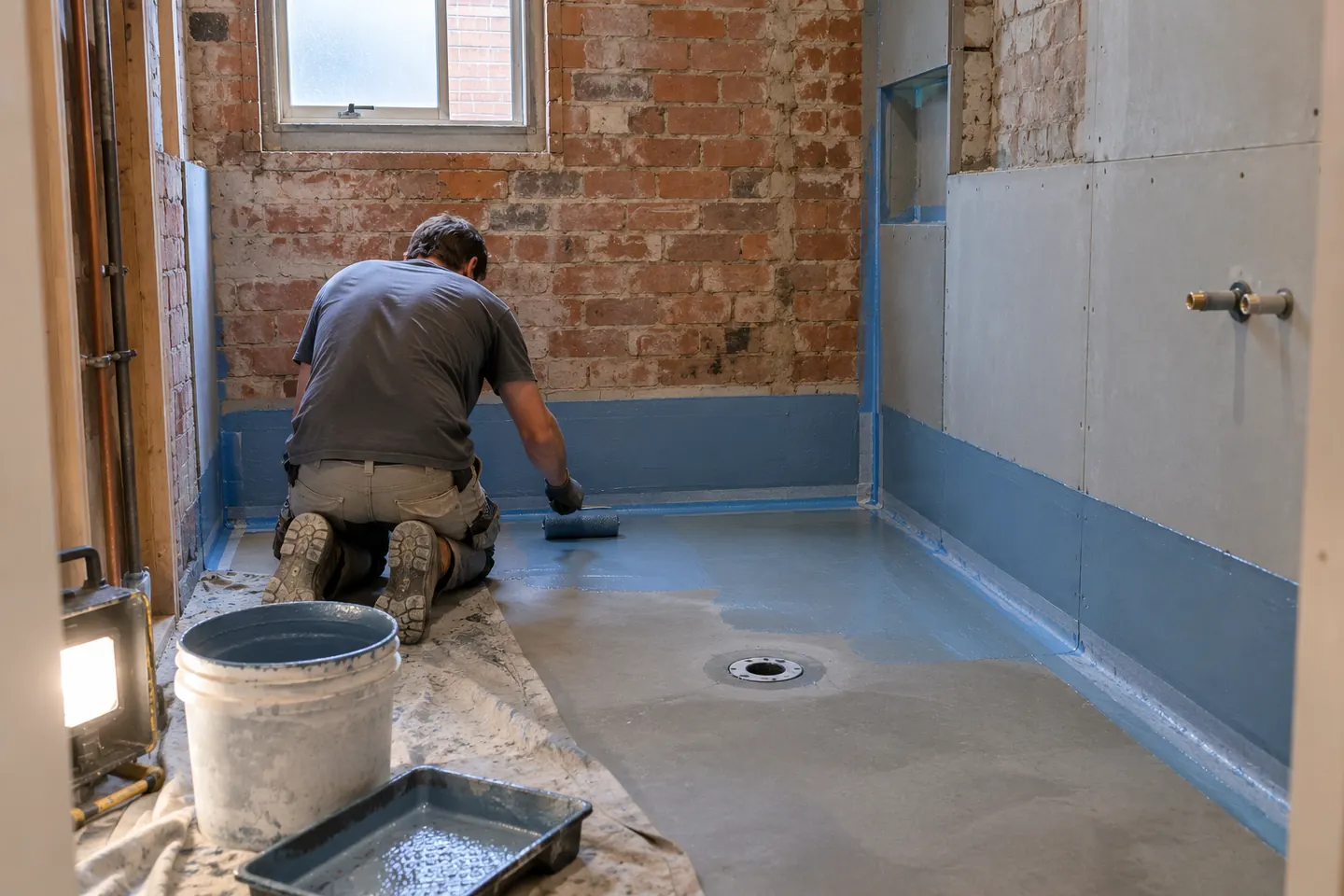
For most bathrooms we use a liquid-applied membrane, laid in multiple coats with reinforcing at every internal corner, floor-wall junction and penetration.
Key details:
- Bond breakers at junctions, so movement in the building does not split the membrane
- Puddle flanges at every floor waste, so water that gets past the tile reaches the drain rather than the slab
- Upturns at the shower perimeter and full-height protection inside the shower zone
- Treatment behind the vanity and bath, not just in the shower
- Protection at the doorway with a water stop angle, so water does not track under the door into a hallway or bedroom
Hobless and level-entry showers
A shower floor level with the bathroom floor is the most requested feature in compact bathrooms, because it lets the room read as one space. It is also the detail most often done badly.
The requirements are straightforward: enough fall inside the shower, a drain in the right place (a linear drain along the wall or at the shower edge works well), a water stop or grate at the shower boundary where required, and a membrane that turns up correctly at every edge. The screed and drain set-out happen before the membrane, so they are decided early.
Salt air and humidity
Coastal humidity does not break a membrane, but it affects everything around it. Grout and silicone stay damp for longer, mould grows more readily, and in a windowless bathroom the ceiling suffers. A properly ducted exhaust fan is part of protecting the investment.
Certificates and paperwork
At the end of the waterproofing stage you should receive a waterproofing certificate naming the product and the area treated. Keep it with your strata records. If you sell, a buyer's inspector may ask for it; if something ever goes wrong, it is the starting point.
We also recommend photographs of the membrane before tiling, especially at the drains and junctions. They cost nothing and answer questions years later.
Flood testing
For bathrooms over another unit, we can arrange a flood test before tiling — the floor is plugged and filled for a set period and checked below. It adds a day, but many owners corporations are glad to see it, and it provides peace of mind for everyone.
When waterproofing is the whole job
Sometimes a leak appears in a bathroom that is otherwise in good shape. In most cases a sound repair still means removing the floor tiles and bed, at least in the shower, to replace the membrane. Injected sealers and re-grouting can buy time, but they rarely fix a failed membrane. We will explain the options, and whether a full renovation makes more sense than a repair.
Who does the work
Renovation work is carried out in partnership with Coastal Renovation Group, a licensed NSW builder, with waterproofing carried out by appropriately qualified trades. Licence and insurance details are provided on request.
See the process page for where waterproofing sits in the program. Call 02 5121 7922 or describe the problem.